
Lemon Law Flowchart - A Simple Way to See Where Your Vehicle Stands
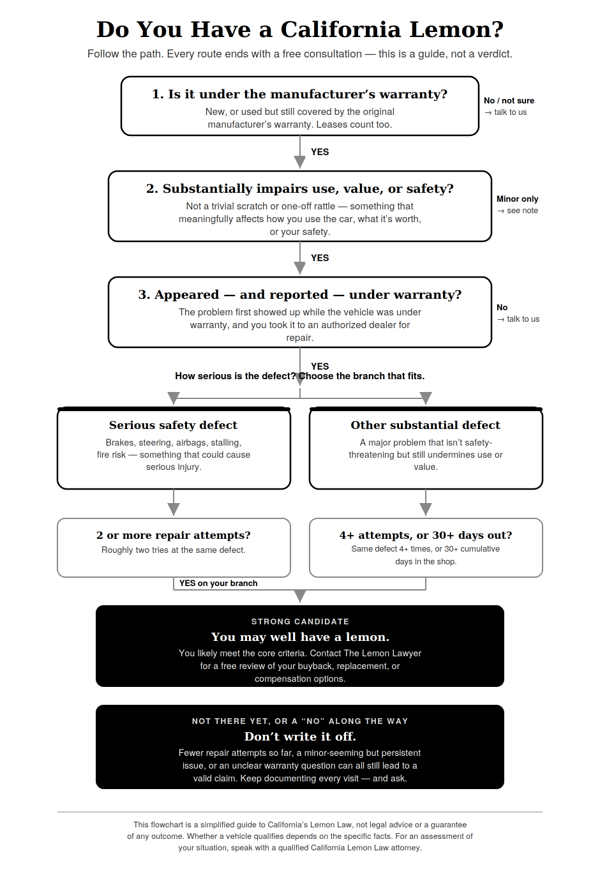
California’s Lemon Law can feel complicated from the inside, especially when you are the one making repeated trips to the service department. The flowchart below distills the core of the law into a single path you can follow with a glance or two. It will not decide your case — only a review of your specific facts by a qualified legal professional can do that — but it is a fast way to see whether your situation points toward a claim, and what to do next.
How to Read the Flowchart
The chart moves through the same questions our attorneys ask when first evaluating a case. Each step narrows things down, and the branch near the bottom reflects an important nuance in the law: serious safety defects are held to a lower repair-attempt threshold than other problems. Here is what each step means in practice.
Step 1: Is the vehicle under the manufacturer’s warranty?
California’s Lemon Law is tied to the manufacturer’s original written warranty. A new vehicle qualifies, and so does a used or leased one that is still covered by that original warranty. What matters is the warranty, not the vehicle’s age or mileage. If you are unsure whether your coverage applies, our guide on whether you qualify for California Lemon Law explains the warranty requirement in more detail.
Step 2: Does a defect substantially impair use, value, or safety?
Here it is. The heart of the law. A defect must be substantial — something that meaningfully affects how you use the vehicle, what it is worth, or your safety — not a trivial cosmetic flaw. A single minor rattle usually will not qualify on its own, but a persistent problem, or several smaller defects taken together, often can. If your issue feels minor but keeps coming back, do not rule yourself out at this step.
Step 3: Did the defect appear and get reported under warranty?
The problem should have first appeared while the vehicle was under warranty, and you should have brought it to an authorized dealer for repair. Reporting the issue while coverage is active is what preserves your rights, even if the claim itself comes later. This is also why keeping thorough records from the first visit matters so much.
Step 4: Have there been enough repair attempts?
This is where the safety distinction comes in. For a serious safety defect — one that could cause death or serious injury, such as a brake, steering, or airbag failure — as few as two repair attempts may be enough. For other substantial defects, the benchmark is generally four or more attempts at the same problem, or more than 30 cumulative days out of service during the warranty period.
There is no rigid magic number, and serious cases can qualify sooner. Our overview of how many repair attempts the law expects breaks down the thresholds and the exceptions.
Where the Paths Lead
- Strong candidate. If you followed the path with affirmatives the whole way through, you likely meet the core criteria, and it is worth having your case reviewed. Qualifying vehicles may be entitled to a manufacturer buyback, a replacement vehicle, or cash compensation.
- Not there yet, or a “no” along the way. Landing on the amber outcome does not mean you have no claim. Fewer repair attempts so far, a persistent but minor-seeming defect, or an unclear warranty question can all still support a valid case. The right move is to keep documenting and ask.
Why Documentation Decides So Many Cases
Whichever path you land on, the strength of a Lemon Law claim usually comes down to records. Repair orders, service history, and warranty paperwork are what prove a defect was reported, recurred, and went unfixed. Our repair documentation guide explains exactly what to keep and what to check before you leave the dealership. And if you drive an electric or plug-in vehicle, our EV Lemon Law guide covers the battery, charging, and software issues unique to those cars.
Schedule Your Free Consultation
If the flowchart points toward a possible claim — or if you are simply not sure — the next best step is a conversation. Contact The Lemon Lawyer today for a free consultation. We will review your repair history, explain your options, and help you determine whether your vehicle qualifies under California Lemon Law.