
Two Ways California’s Lemon Law Can Make Things Right
When a vehicle is declared a lemon under California law, you are typically entitled to one of two remedies: a buyback, where the manufacturer repurchases the vehicle, or a replacement, where you receive a comparable new automobile. Both methods are meant to undo the harm of being sold a defective vehicle, but they work differently, and the best fit for you depends entirely on your situation.
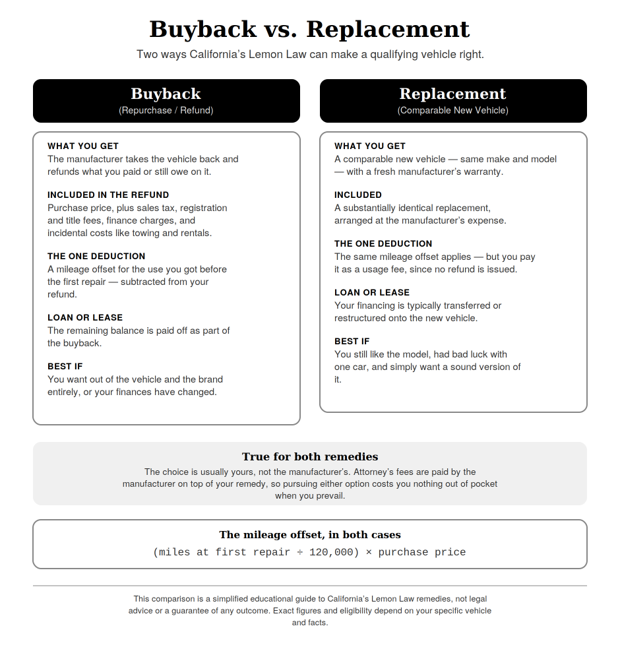
The comparison below lays them side by side, and the sections that follow explain what each one really involves.
Not sure which remedy fits your situation? Contact The Lemon Lawyer for a free review.
The Buyback (Repurchase)
In a buyback, the manufacturer takes the defective vehicle back and refunds what you paid or still owe. This is the remedy most people probably picture when they think of a lemon law claim, and for many consumers it is the cleanest way to move on.
A California buyback is not an arbitrary number. The Song-Beverly Consumer Warranty Act spells out what it must include:
- The money you put in. Your down payment and the monthly payments you have made.
- What you still owe. The remaining balance on your loan or lease, paid off as part of the buyback.
- Taxes and fees. Sales tax, registration, title fees, and finance charges tied to the purchase.
- Incidental costs. Out-of-pocket expenses the defect caused, such as towing or rental cars.
From that total, the manufacturer is allowed one main deduction: a mileage offset for the use you got out of the vehicle before the trouble started. More on that below.
The Replacement
With a replacement, instead of a refund you receive a comparable new vehicle — the same make and model, with a fresh manufacturer’s warranty, arranged at the manufacturer’s expense. For a driver who genuinely likes the vehicle and simply drew the short, malfunctioning straw, this can be the more appealing path.
A few practical points shape whether replacement makes sense. The replacement is meant to be substantially identical, so if your exact configuration is no longer available, matching it can get complicated. The default often shifts back toward a buyback. Your financing is typically moved onto the new vehicle rather than unwound. And the same mileage offset that would reduce a buyback still applies — but because no cash refund is being issued, you generally pay it as a usage fee to complete the exchange.
The One Shared Deduction
Whichever remedy you choose, California law lets the manufacturer account for the miles you drove before the defect was first brought in for repair. It treats 120,000 miles as the expected life of a vehicle and prorates accordingly. The formula is fixed: the miles on the vehicle at your first repair visit for the defect, divided by 120,000, multiplied by the purchase price.
Two details matter. First, the offset is frozen at your mileage on that first repair visit — not today’s odometer reading — so the miles you put on the car while fighting the problem do not count against you. Second, manufacturers sometimes understate the figures that figure into this calculation, which is one of the most common places a buyback offer falls short of what the law requires.
What is Right for You?
There is no universally correct answer; it depends on what you want out of the outcome.
- A buyback often makes sense when you want to be done with the vehicle and the brand altogether, when your financial situation has changed, or when you would simply rather have your money back and decide fresh.
- A replacement often makes sense when you still like the model, believe you were unlucky with one particular car, and want a sound version of essentially the same vehicle without the disruption of shopping again.
In most cases the choice is yours to make, not the manufacturer’s. An experienced attorney can model both outcomes for your specific vehicle so you are choosing with real numbers in front of you rather than guessing.

What Both Remedies Have in Common
Beyond the mileage offset, two things are true no matter which path you take. California’s Lemon Law typically requires the manufacturer to pay your attorney’s fees separately when you prevail, so pursuing either remedy costs you nothing out of pocket. Both outcomes depend on first proving your vehicle qualifies — which comes down to your repair history and documentation.
Recent California decisions have also strengthened consumer protections in how a buyback is calculated, including confirming that a trade-in or sale of the vehicle before the buyback is completed should not be used to quietly reduce what you are owed. These details are easy to miss on your own, and they are precisely where a manufacturer’s first offer tends to fall short.
Why Work with the Lemon Lawyer?
Comparing two remedies in the abstract is one thing; knowing which one maximizes your recovery is another. The Lemon Lawyer brings more than 25 years of California Lemon Law experience, over 3,000 successful cases statewide, direct attorney communication with no assistants or paralegals in between, no upfront legal fees, free consultations, and representation across the entire state.
Because California Lemon Law generally requires manufacturers to pay attorney’s fees when consumers prevail, there is no cost to speak with our team about your claim.
Schedule Your Free Consultation
If your vehicle may qualify as a lemon, you do not have to decide between a buyback and a replacement alone. Contact The Lemon Lawyer today for a free consultation. We will review your repair history, explain both options with your actual numbers, and help you pursue the outcome that serves you best.
Related Reading
These guides expand on qualifying, filing, and what happens to your financing:
- Do I Qualify for California Lemon Law?
- How to File a Lemon Law Claim
- Your Repair Visit Documentation Checklist
- What Happens to Your Loan or Lease Under Lemon Law
- California Lemon Law: Latest Updates
* The above comparison is a simplified educational guide to California’s Lemon Law remedies, not legal advice or a guarantee of any outcome. Exact figures and eligibility depend on your specific vehicle and circumstances.